
A new study found confirmed CTE in at least 24.5% of former NFL players who died during a recent six-year period. That is not the same as saying one in four current players has the disease. The distinction matters—but it should not soften the urgency.
By MindSet PrTMS | September 2026
Football knows how to count almost everything.
Yards after contact. Quarterback pressures. Snap speed. Hang time. The fraction of a second between an opening and a collision.
What the sport still cannot count with confidence is the damage that may accumulate across thousands of hits, including the ones that never produce a diagnosed concussion and never stop a game.
That uncertainty is back in the spotlight just as the NFL season begins.
In August, The BMJ published the largest population-based effort yet to estimate chronic traumatic encephalopathy, or CTE, among deceased former NFL players. Researchers identified 1,712 former players who died between 2008 and 2021. Of the 338 whose brains were examined, 315—93.2%—had CTE.
That number is dramatic. It is also drawn from donated brains, a group more likely to include families already concerned about a loved one’s symptoms.
So the researchers asked a better question: What can be said when every known former NFL player who died during the period is included in the denominator, whether or not his brain was donated?
For 2016 through 2021, 878 former players died. Researchers confirmed CTE in 215 of them. That means at least 24.5% of the full group had CTE at death. The other 643 brains were not examined, so the real percentage cannot be known from this study. The authors calculated a possible range extending as high as 97.7%, but that upper bound is a mathematical ceiling, not a realistic point estimate. The most defensible takeaway is the floor: nearly one in four of the former NFL players who died during those six years was confirmed to have CTE. (The BMJ study; PubMed record)
What the headline does not tell us
The study does not show that one in four current NFL players has CTE. It does not establish the prevalence among living retirees. It cannot tell a 28-year-old linebacker what will happen to him at 58.
CTE can still be confirmed only by examining brain tissue after death. Researchers are working to identify reliable biomarkers in living people, but they are not there yet. Former quarterback Matt Hasselbeck recently volunteered for an ongoing Boston University study that uses cognitive testing, blood samples, MRI and PET scans in search of that breakthrough. He is participating, he told the Associated Press, because some former teammates have not been as fortunate as he has. (Associated Press)
A second paper, published September 2 in JAMA Network Open, offers another piece of the puzzle. Researchers studied 33 former NFL players who completed standardized cognitive testing while alive and were later confirmed to have CTE at autopsy. Learning and memory impairment appeared in 63% of those with enough data in that domain, followed by executive-function impairment in 52% and language impairment in 41%. Greater accumulation of abnormal phosphorylated tau protein was associated with worse memory performance. (JAMA Network Open study)
It is an important clue, not a diagnostic test. Thirty-three men from a selected group cannot represent every player, and symptoms such as forgetfulness, depression, irritability or sleep disruption can arise from many treatable conditions. The CDC cautions that having such symptoms does not mean a person has CTE. It also notes that the strongest concern is long-term exposure to repeated head impacts—not the assumption that one concussion inevitably leads to the disease. (CDC)
That nuance should prevent panic. It should not become an excuse for inaction.
Craig McEwen knows what happened beyond the highlight reels
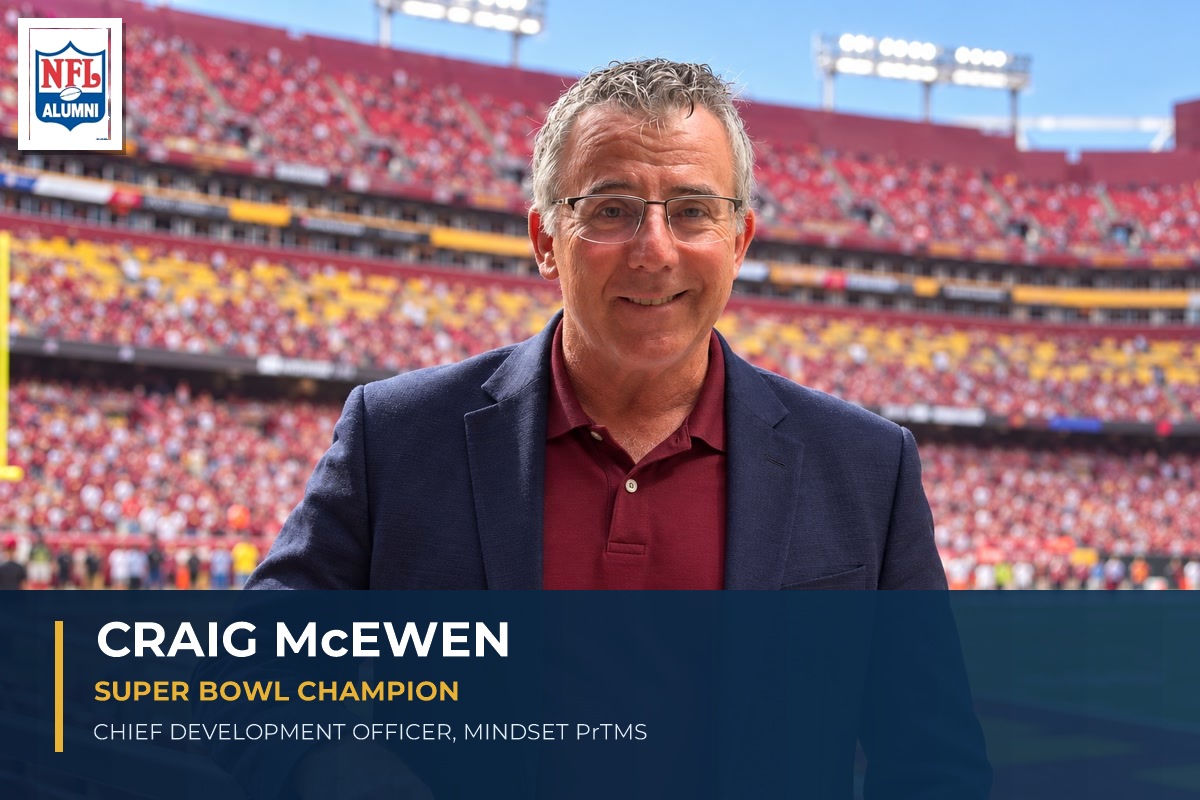
Craig McEwen played five NFL seasons at tight end for Washington and San Diego. He appeared in 54 games, caught 108 passes for 1,310 yards and earned a Super Bowl ring. Those facts fit neatly on a player page. (NFL career statistics)
The rest of his story does not.
In a 2025 long-form interview, McEwen described when he first realized the damage might extend beyond his body. After football, he bought a bar and discovered that work he once handled easily—tracking orders, sending checks and keeping the books—had become difficult. Sleep deteriorated. The mental fog gave way to irritability, forgetfulness and trouble organizing ordinary tasks. “I started forgetting about daily things,” he said. (Craig McEwen interview)
That account is consistent with what McEwen told KFF Health News in 2023. His job, he explained, was to protect the quarterback in an era when “you were allowed to hit people in the head.” He recalled regular concussions and using ammonia packets to pull himself back into the game. Years later, he described suicidal thoughts, anger, depression, memory problems, chronic pain and a period of profound isolation. (KFF Health News interview)
The public description of the documentary Healing Agent: Concussed—The NFL Afterlife of Craig McEwen adds another layer: McEwen played through physical pain and a fog caused by repeated blows to the head, then dealt after retirement with depression and anger that he associated with concussions. (Documentary record and synopsis)
There is an era of football contained in that sentence. Staying on the field was part of staying employed. “Shaking it off” was not simply a phrase; it was a survival strategy. A player could be admired for playing hurt while quietly losing the ability to describe what hurt.
McEwen later accepted an offer to be evaluated and receive PrTMS. In the interview, he recalled feeling somewhat less tense early in the process and said that, several weeks in, he experienced his first restorative night of sleep in roughly 22 years. Over time, he associated improved sleep and mental clarity with a greater ability to care for himself and reconnect with his daughter. Those are McEwen’s personal observations—not proof that PrTMS treats a brain injury or CTE, and not a result that can be promised to someone else.
McEwen now serves as MindSet’s chief development officer and an NFL Alumni Ambassador. His value in this conversation is not that his experience proves what happened in every former player’s brain. It is that he can describe the space between a medical term and a life: the fog, the mood changes, the strain that other people may not see, and the difficulty of asking for help after years of being rewarded for pushing through.
Vince Abbott knows the pressure to stay ready
Vincent “Vince” Abbott brings a different vantage point. Abbott was a professional placekicker who appeared in 23 games for the San Diego Chargers in 1987 and 1988. His role and exposure were not McEwen’s, and his story should not be used to imply a concussion history he has not publicly described. What Abbott can speak to is the employment pressure surrounding professional football. (NFL career statistics)
In a 1987 Los Angeles Times profile built around an extended interview, Abbott recounted attending six NFL training camps and spending a season in the USFL before finally earning the Chargers job. For years, he kept practicing while his wife supported them, often kicking at an elementary school until dark. “When you have been on the spot as much as I have, you get used to it,” he said. (Los Angeles Times interview)
That pressure is relevant to brain health even though Abbott’s interview was not about CTE. A player whose livelihood depends on the next rep may hesitate to report anything that could take him off the field. McEwen’s account shows what that silence can look like years later. Together, their histories put practical questions ahead of slogans: Who decided whether a player returned? Did he feel safe reporting that he was not right? What evaluation happened the next day—or the next year? What followed him home, away from the cameras?
Those questions are not accusations. They are the beginning of responsible care.
The game is safer in measurable ways. The problem is not solved.
It would be wrong to write as if football has stood still. The NFL reported a record 538 in-game concussion evaluations and 26 medical timeouts during the 2025 season. More than 98% of players wore top-performing helmets. In separate 2026 equipment data, the league and NFL Players Association said top-performing helmets were associated with nearly 30% lower on-field concussion rates than models classified as “not recommended.” (NFL 2025 injury data; 2026 helmet testing)
That is real progress. Better equipment, independent evaluations, medical timeouts, stricter return-to-play decisions and a culture in which players are more willing to report symptoms can reduce harm.
But a better helmet is not a force field. And a concussion count does not capture every head impact. The CDC’s definition of repeated head impacts explicitly includes blows that do not produce immediate symptoms. That is why the next frontier is not merely identifying the spectacular collision. It is understanding total exposure, improving long-term follow-up and making it normal for athletes to seek care after their playing days end.
For a current player, former player or family member who is worried, the most useful response is neither denial nor self-diagnosis. It is to document changes, seek a qualified medical evaluation and treat the conditions that can be assessed now. Memory problems, depression, anxiety, poor sleep and headaches deserve attention regardless of whether they will ever be connected to CTE. After a suspected concussion, the CDC advises immediate removal from play, no same-day return and clearance from a healthcare provider before returning. (CDC HEADS UP)
Where MindSet fits—and where it does not
MindSet does not diagnose CTE. PrTMS should not be presented as a way to prevent, reverse or cure it.
MindSet’s role begins with something more grounded: listening to what a person is experiencing, conducting a physician-led evaluation and helping determine an appropriate next step. The clinic uses clinical assessments and quantitative EEG data to personalize repetitive transcranial magnetic stimulation protocols and monitor response over time. TMS technology has FDA-cleared indications that include major depressive disorder; whether it is appropriate for a particular person or symptom requires an individual clinical decision. (FDA guidance on rTMS systems; MindSet’s approach)
That distinction is essential. People with a history of head impacts should not be sold certainty that medicine does not yet have. They should be offered a careful assessment, honest limits and evidence-based options for conditions that can be evaluated and treated today.
Football’s hardest brain-health question remains unanswered: Who develops CTE, when does it begin and how can it be identified before death?
The new research makes waiting passively harder to defend. The number is not a verdict on every player. It is a signal—strong enough to demand better exposure reduction, longer follow-up, more volunteers for living-player research and a culture in which saying “something has changed” is treated as strength.
The season will give us plenty to count. Brain health should be one of them.







Leave A Comment